


The AutoStore System in Detail: Components, Partners, Planning – A Guide for Decision-Makers
Understanding AutoStore: Everything about robots, ports, planning and integrators – for logistics managers, IT managers and project planners
AutoStore™: Development, Performance Metrics, Comparisons and Integration in Warehouse Logistics
In a nutshell: AutoStore™ is an automated storage and picking system in cube storage design that drives efficiency and space savings in intralogistics. The system has spread rapidly in recent years and is now considered a benchmark for automated small parts warehouses. Especially in e-commerce and spare parts logistics worldwide, logistics managers rely on AutoStore to meet growing demands for throughput and delivery speed. This expert article examines the history and development of AutoStore, presents performance metrics of the system, introduces official integration partners and highlights complementary technologies frequently used in combination with AutoStore.
Table of Contents
- Introduction
- How the System Works
- The Grid & Structural Integration
- Bins
- Robot Models & Selection
- Port Comparison
- Controller & IT Infrastructure
- Planning & Requirements
- Costs
- Fire Protection
- System Integrators
- FAQ – Frequently Asked Questions
Development and History of AutoStore™
AutoStore was founded in 1996 in Norway by Jakob Hatteland and Ingvar Hognaland. Hognaland, inspired by the Rubik's Cube, developed the concept of a cubic storage automation system to eliminate unused air space in storage racks – instead of conventional shelving, bins are stacked on top of each other in a grid and retrieved by robots. After several years of development and a successful prototype, Hatteland began commercializing the system in 2004 through a network of selected distribution and integration partners. This partner model proved effective: AutoStore initially grew in Northern Europe and spread worldwide from the 2010s onwards.
A milestone was the international expansion starting in 2011, when the first installations were implemented in Central and Western Europe, North America and Asia. Today AutoStore has a global presence and has become the de facto standard for automated small parts storage. With currently around 1,550 installed systems serving over 1,000 customers worldwide, AutoStore is the market leader in cubic small parts storage. In over 50 countries – including numerous installations in Germany, Austria and Switzerland – AutoStore helps companies modernize their warehouse processes. The significance of this invention was recognized in 2023, when founders Hatteland and Hognaland were inducted into the Logistics Hall of Fame. AutoStore holds over 1,600 patents and has permanently shaped warehouse technology.
How Does the AutoStore System Work?
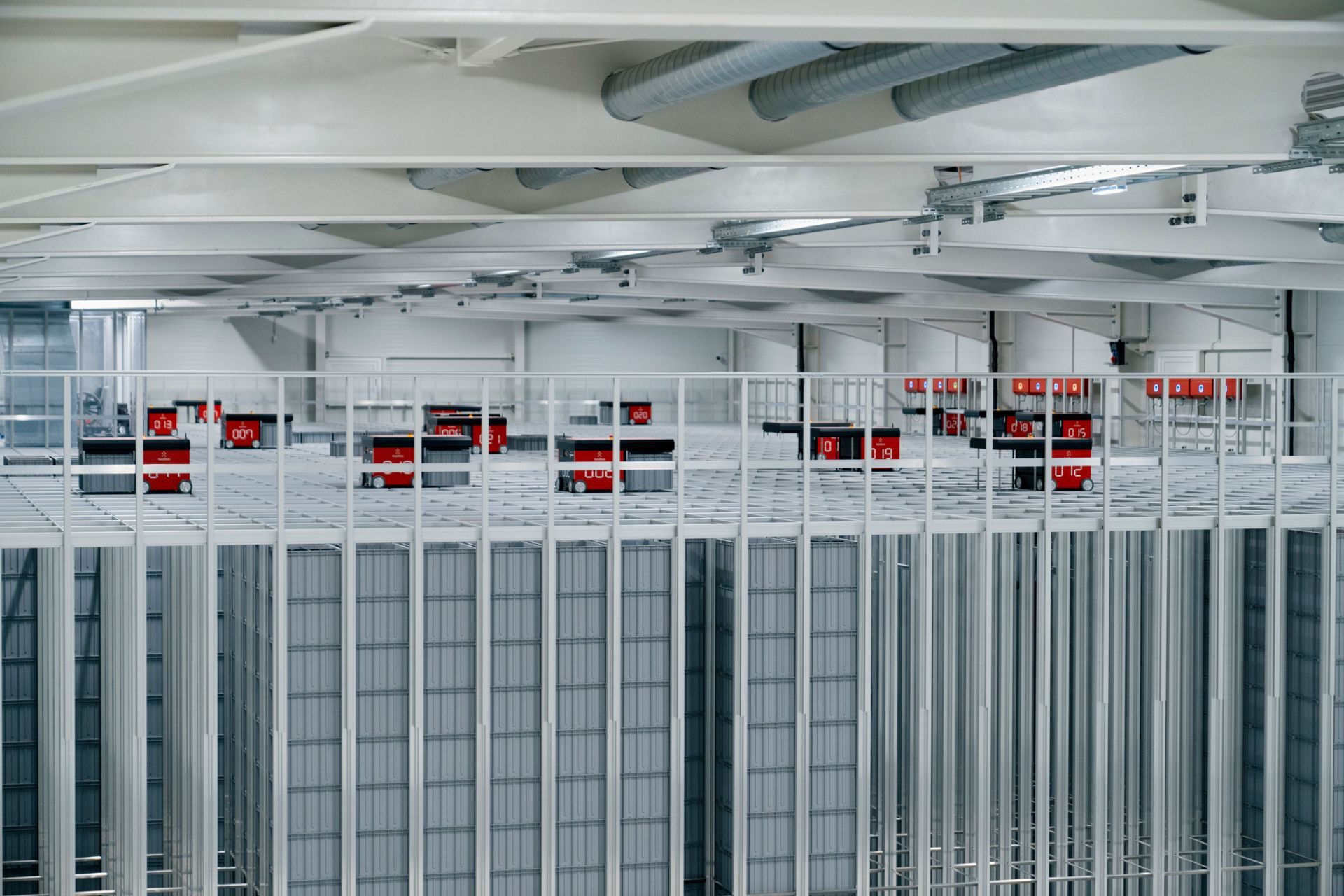
AutoStore is an automated storage and picking system for small parts based on a cube-shaped aluminum grid. In this grid, bins are stacked vertically without the need for conventional aisle access. The surface of the grid serves as the driving surface for autonomous robots that lift individual bins, rearrange them and transport them to transfer points.
#### Workflow of a Typical Warehouse Process in AutoStore
1. Identifying the Storage Location When a storage retrieval request is made, the AutoStore system receives information from the upstream warehouse management system (WMS) about which item is needed. In many implementations, AutoStore is treated by the WMS as a single storage area. The exact location of items within the grid – i.e., which bin contains which item – is managed by AutoStore's proprietary control software. This manages the assignment of items to bins and knows their exact position in the system. 2. Access by Robots Robots on the grid surface handle access to the target bin. If it is not on top, the bins above it are temporarily removed and stored on adjacent fields. The required bin is then picked up and brought to the next available port. 3. Handover at the Port The robots deliver the bin to a picking station – called ports. There, order picking is performed by employees or handover to downstream automation solutions. After completion, the bin is returned to the grid.
#### Storage Logic and System Behavior During Return Storage
AutoStore does not perform explicit storage location optimization in the classic sense. Rather, the distribution of item positions results from the sequence of accesses. When an item is needed, the robots lift it from the grid – after retrieval, the bin is then stacked on top.
This creates a natural effect:
- Frequently used items tend to be closer to the surface, because they are moved more often and thus repeatedly placed on top.
- Less frequently needed items remain further down in the long term, since they are only rarely lifted.
This system-inherent distribution – sometimes referred to as "Natural Slotting" – functions without separate analysis or reorganization.
#### Preparatory Movements by the System
Another efficiency factor lies in the anticipatory operation of the robot fleet: There is usually some time between the receipt of a picking order in the warehouse management system and the actual provision at the port. AutoStore uses these time windows to initiate preparatory steps – for example:
- Exposing bins located deeper that will soon need to be accessed
- Restacking bins to clear the path to prioritized items
- Pre-positioning frequently needed items near a port
These preparatory processes help reduce access times and continuously supply workstations with replenishment – without requiring active warehouse reorganization. Let's now look more closely at the individual modules:
The AutoStore Grid: Foundation of Warehouse Automation
The grid is the central structural element of the AutoStore system. It forms the storage framework on which the robots travel and under which the bins are stored. The construction is completely modular – both in area and height. Dad

Did you find this article helpful?

Order Picking – A Core Process in Logistics
Fundamentals, challenges and different methods of the order picking process.

Robotic Piece Picking: Components, Technologies, and the Difference Between Cobots and Industrial Robots
Robotic Piece Picking closes the final gap in logistics automation and reveals which technologies make the difference.

Planning Shuttle Warehouse Systems the Right Way – Answers from the even Webinar with RocketSolution
Shuttle warehouses are often planned based on gut feeling – yet it is concrete metrics that determine success or miscalculation.

Storing Ugly Goods automatically – answers from the even Webinar with advasolutions
What Ugly Goods are, why conventional systems reach their limits here, and how carrier-free storage works in practice.