


Sustainability and Logistics - Logistics as the Engine of the Circular Economy?!
The supply chain in a circle. What opportunities does this create? And what does it take to get there?
In a nutshell: The Circular Economy is replacing the traditional linear economic model. Not overnight, of course. It is a transformation — and it has already begun. In small steps. Because circular flows of goods will inevitably emerge. One way or another. Whether "by design" or "by disaster" remains to be seen. And logistics will be the pivotal force in this shift. It will have to be. That, at least, is a demand I am making. My demand. But will the industry proactively embrace this responsibility? Will it shape the infrastructure for a Circular Economy? Will it establish business models to generate profit — not solely out of a sense of public interest, but also for sound commercial reasons? Or will it ultimately be forced to do so by customers and consumers? Put differently: Will logistics drive the Circular Economy as its engine, or will logistics be driven by the Circular Economy?
In an earlier blog post, I provided a general introduction and overview of the Circular Economy. Anyone wishing to revisit — or perhaps read it for the first time — will find the link in the references below. [1] I now want to turn to the question of what implications the Circular Economy has for the supply chain and, by extension, for logistics. This will be explored across several blog posts.
From the Linear Economy to the Circle – Implications for the Supply Chain
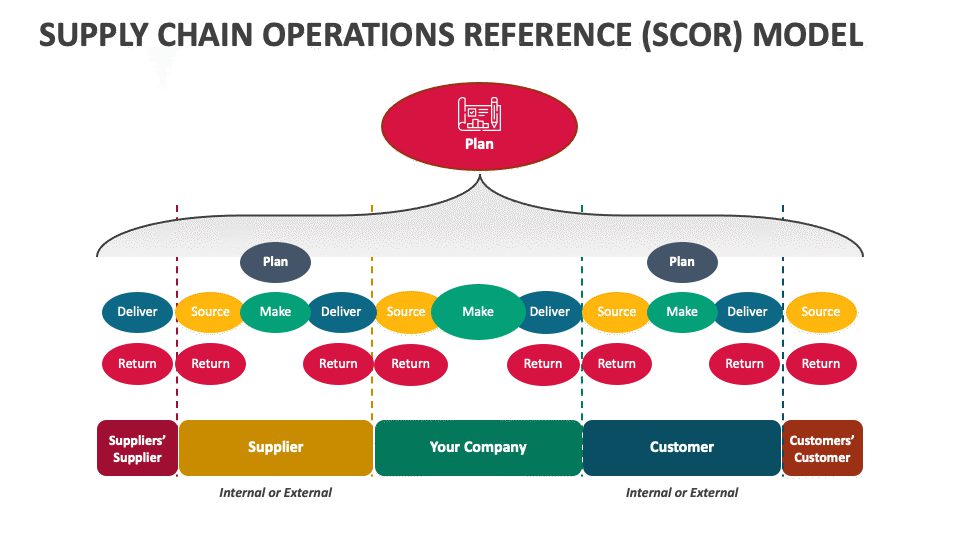
Today, logistics functions as an integral component of established supply chains, operating according to the principle of "delivery – waste handling – recycling – returns." Supply chains are typically represented using the Supply Chain Operations Reference model (SCOR), developed by an independent body, the US-based Supply Chain Council (SCC).
Through standardization, this model supports the planning and optimization of logistics across all members of a supply chain, with the aim of streamlining operations. The underlying idea is the cross-industry harmonization of all processes throughout the entire value creation process. The SCOR model looks as follows:

This is all familiar territory. And it immediately becomes clear how deeply ingrained the linear economic mindset is. Supply chains are, on paper, long, linear chains of processes — running from left to right. In the Circular Economy, such linear flows largely disappear and are replaced by diverse, complex return and reintegration flows. [3] While (partially) circular economic flows have already been established within supply chains, a genuinely focused and collaborative end-to-end perspective is still missing. This is precisely where the Circular Economy picks up.
If the linear economy is to become a circle, the SCOR model must be rethought accordingly. The Circular Supply Chain model, developed by Ernst & Young and published in 2022, depicts the supply chain within a Circular Economy — translating the full circular concept into a working model.

The traditional economic model and its logistics value-creation networks have so far been characterized by the linear material flow illustrated above — a flow that, at its end, too often culminates in the disposal of consumed products by the end consumer, with significant material losses. Or purchased products simply gather dust in basements and drawers around the world. The Circular Economy model replaces this linear view with a circular representation, thereby closing the loop from the consumer (5.) back to the sub-supplier (1.). In the classic SCOR model, end-customer-side activities such as Collect, Proof (Verification), and Re-X (where X stands for the various forms of reprocessing — as explained in my Circular Economy fundamentals blog post [1]) were entirely absent.
It is noteworthy that micro-cycles emerge between the individual value creation stages. EY refers to these as Sub-Supply Cycles. [3] The key challenges — beyond a shift in mindset — lie in integrating circular economy actors into existing supply chains and, related to this, in keeping materials circulating within production and economic systems. This is what will enable the paradigm shift from supply chain management to the management of Circular Supply Chains. [4]
The Role and Responsibility of Logistics within Micro-Cycles
The primary goal of the Circular Economy is, first and foremost, to secure the supply of raw materials by conserving resources and increasing resource effectiveness. The speed of circular flows is critical in this context: the efficiency of inventory management in the Circular Economy increases as flow velocity decreases. Companies must therefore rethink strategies based on planned obsolescence and instead manufacture high-quality, long-lasting products. [5] Keeping products and materials in circulation is intended to enable the decoupling of economic growth from resource consumption. [4]
Logistics, as the central pivot point, plays a crucial role in this. It will take on more — and more important — responsibilities, while simultaneously becoming more granular and more local. [3] The goal is not to create a single, globalized Circular Economy. Instead — as described above — many small, regional micro-cycles will form. For the smaller the cycle in terms of activities and geographic scope, the more profitable, faster, and resource-efficient it becomes. The strategy must therefore be to appropriately connect these many, diverse, small circular economies at local, regional, and global levels. [5]
This brings me back to a question I have raised before regarding the (societal) value of logistics — explored in this blog post.[6]. Because what this means for logistics is the task of deliberately aligning logistical processes with their impact on resource productivity and resource effectiveness — rather than focusing exclusively and primarily on short-term financial returns. I am not calling for a purely public-interest orientation here; rather, I am raising the question of relevance in a changing future. Logistics can and should position itself now as part of the Solution, not part of the problem, b

Did you find this article helpful?
Sustainability and Logistics – A (Beginner's) Practical Guide to Circular Economy for Logistics
The future of logistics is no longer a straight path — it's a circle. This practical guide helps you take your first steps into the loop.
Sustainability and Logistics – Circular Economy and Resilience
Blog post 2 of 2: Those who keep things in circles get through crises better than those who constantly hope for resupply.
Pay Transparency in Logistics: What's Coming for Fleet and Warehouse Operations
On the new EU directive, its concrete impact on logistics companies, and why waiting is the most expensive option.

The Underestimated Climate Problem in the Warehouse
On sustainability in automated small parts warehouses. An interview with Timo Landener on energy, density and CO₂ in intralogistics.