


Labour Market 2025/2026 Comparison
Warehouse workers in focus - a data-driven analysis.
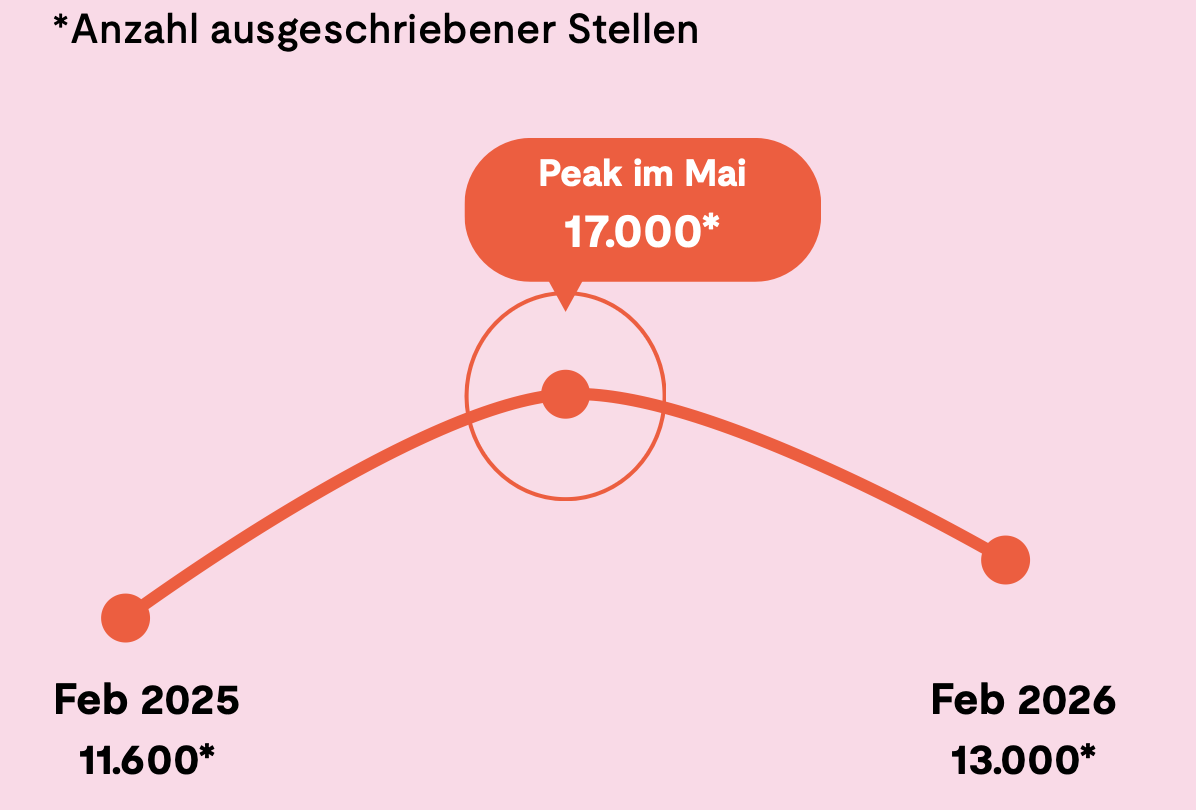
The labour market for warehouse workers has changed noticeably within a year. Between February 2025 and February 2026, a differentiated picture emerges: pronounced seasonal fluctuations, a temporary hiring boom and a shift in market conditions in favour of employers.
The following insights are based on a comprehensive analysis of Indeed Hiring Analytics data for the period from February 2025 to February 2026.
Hiring Boom and Subsequent Cooling
At the beginning of 2025, the labour market was at a comparatively low level with around 11,600 advertised positions for warehouse workers. However, a significant increase began in spring, peaking in May 2025 with over 17,000 positions. The summer months also remained at a consistently high level, partly in preparation for the Black Friday and Christmas season.
However, this boom proved unsustainable: towards the end of 2025, the market cooled noticeably and stabilised at around 13,000 open positions in early 2026.
Notably, despite the temporary increase in positions, the number of active employers continued to decline. This indicates increasing market concentration: fewer companies, but with higher staffing needs.
Competition for Talent
The candidate side also shows dynamic development. In October 2025, the number of job seekers reached its peak at over 339,000, before declining significantly in December – due to seasonal factors.
A key indicator is the ratio of job seekers per position:
- Early 2025: 28 candidates per position
- May 2025: 16 candidates per position
- February 2026: 23 candidates per position
This means: During early summer 2025, employers had greater difficulty filling open positions. Currently, the situation has eased significantly and is approaching the level from early 2025 again.
The continuous increase in available CVs is also positive for employers. Within one year, the Indeed database grew by more than 7,700 profiles. For recruiters, this means: better selection options and more efficient placement processes.
Job Seeker Behaviour
One clear trend persists: Mobile First. Around 70% of all job searches are conducted via mobile devices.
Search terms also provide important insights. Keywords such as "full-time", "part-time" and "mini-job" continue to dominate. At the same time, "career changer" remains a consistently highly sought-after term.
This shows: Flexibility and low entry barriers are crucial for applicants.
What Does This Mean Specifically for Employers?
- Mobile optimisation is mandatory: Job advertisements must load quickly, be clearly structured and enable applications with just a few clicks.
- Compact content instead of long texts: Candidates scan content on mobile devices – key information such as salary, working hours and location should be immediately visible.
- Use keyword optimisation strategically: Terms such as "full-time", "part-time", "mini-job" and "career changer" increase discoverability.
- Simplify application processes: Few mandatory fields, ideally one-click applications or simple CV upload.
- Expand target groups: The high demand for "career changer" jobs shows additional potential beyond traditional CVs.
Companies that consider these factors not only increase their visibility, but also significantly improve their conversion rate.
Are Jobs Being Reduced by AI and Automation?
The simple answer would be: Yes. The nuanced answer is: It's more complex.
Automation and AI undoubtedly play a growing role. Processes become more efficient, error rates decrease and scaling is facilitated. Technologies such as automated sorting systems or robot-assisted order picking are already established in the warehouse sector.
At the same time, the data shows: Demand for warehouse workers has not disappeared. It remains volatile and heavily season-dependent, with a slight decline year-on-year. Rather than massive job cuts, we are primarily observing increasing demands for flexibility and more intense competition during peak periods – particularly around Black Friday and the year-end business.
The labour market for warehouse workers is in transition, but not in free fall.
Those who only look at headlines primarily see uncertainty. Those who analyse the data see a system in transformation, not a rapid disappearance of jobs due to AI and automation.

Did you find this article helpful?

The Underestimated Climate Problem in the Warehouse
On sustainability in automated small parts warehouses. An interview with Timo Landener on energy, density and CO₂ in intralogistics.

Leadership in Modern Logistics
Living and passing on growth – an interview with Lorena Garcia from AUTODOC.

WMS vs. WCS: Who's in Control of the Automated Warehouse?
About the differences between WMS and WCS, their roles in the automated warehouse, and when which system architecture makes sense.

Warehouse Control System: The Silent Timekeeper of Automated Material Flows
On the role of the WCS in automated warehouses and why it is critical for stable material flows and efficient processes.