


A gender quota alone is not enough
Why women in logistics carry responsibility but rarely reach the top – with Doreen Fischer.

In a nutshell: In conversation with Doreen Fischer, freelancer for Logistics & Digital Operations, one thing becomes clear: women have long been right in the thick of it – in operations, in leadership, in transformation projects. And yet that invisible barrier remains. That "glass ceiling". Doreen speaks openly about why women often have to prove twice what men simply have "attributed" to them. Why diversity doesn't belong on PowerPoint slides, but in the DNA of companies.
How many careers in logistics really get started
When you ask Doreen how she got into logistics, you don't get a typical "I always wanted to…" story. Instead, you get an honest reality that many people in the industry will probably recognise.
"I didn't actually choose this at all. I kind of fell into it by chance. To be honest, I had no idea what logistics even was."
What she did know was that she wanted to work in a global environment. Languages, cultures, exchange. "I love being internationally connected and working with people from different cultures. Also because of my strong affinity for languages." Today, Doreen works as an independent consultant for logistics and transformation processes, with 16 years of industry experience and a career path that has taken her through virtually every company size.
Equality with limits
Logistics is often described as male-dominated. And yes, that's true. At least when you look at the very top levels. But Doreen emphasises: "I find that in logistics you work alongside a great many women. Women are well represented in operations, including in leadership positions."
So everything is fine?
But then she corrects herself: "Women are in leadership positions, but there is something like a glass ceiling." This "ceiling" has a clear location: "Women's careers often only advance up to a certain level. They reach management levels, take on responsibility – but at the very top, at C-level positions, they remain underrepresented." And that is precisely where the problem begins: visibility, decision-making power, influence.
Why presence does not automatically mean influence
Women are present, but rarely where decisions are made. Sometimes that is not because women are lacking, but because the structures that genuinely support their careers are.
And at times the impression arises that visibility is only created symbolically. "Career opportunities are sometimes generated through formal quotas," says Doreen. What sounds like progress can feel ambivalent. "Then you ask yourself: was I selected because of my qualifications or to fulfil a requirement?"
That is a bitter reality, because it is not the quota that is called into question – it is one's own competence.

Between proving performance and being trusted by default
Many women in male-dominated industries know this feeling: there is no open discrimination, just subtle inequality.
"I often felt that I had to actively demonstrate my competence: 'Yes, I can do this, I have the experience for it.'"
She notices the contrast with men: "My sense was that men more often benefit from an assumption of competence from the outset." Competence is not explicitly questioned, but it is assumed at different speeds.
It is not a loud no. It is a quiet questioning.
And that is precisely what can stall careers – not a lack of talent.
"Women tend to let good work speak for itself."
Doreen is direct: women need to actively claim their place, not hope to be discovered. "Women tend to want to be seen, rather than saying: I want this position now, too."
And this is an uncomfortable but important point: "It is part of the process to state your claim to that position clearly and unambiguously."
Don't wait. Don't hope. Don't stay silent. Instead, say: I can do this. I want this. I will do this.
Symbolism or real change?

Did you find this article helpful?

Attracting Emerging Talent – Centralized Control or Local Responsibility?
On the opportunities and limitations of local responsibility in apprentice marketing.

Generational Transition in Family Businesses with Theresa and Maximilian Meyer
How do you make the transition work? On responsibility, change, and finding the right moment to hand over the reins.
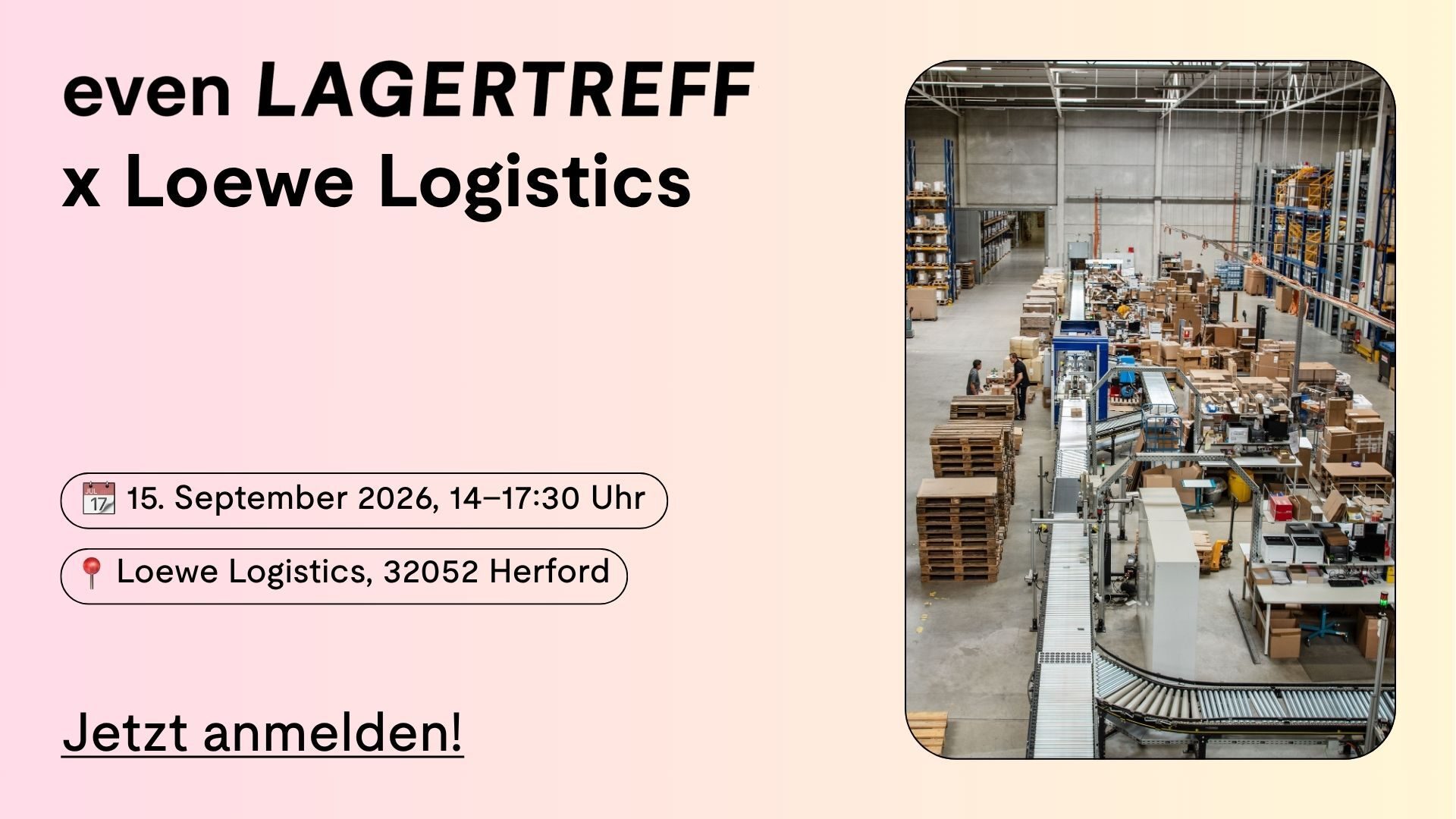
Fulfillment in Practice: Warehouse Meetup at LOEWE Logistics & Care
B2B and B2C fulfillment live in operation – on September 15 in Herford. Register now.

How to Plan an AutoStore System – Answers from the even Webinar with AutoStore
From the first key figures to the finished grid design: How requirements become a warehouse system.