


Sustainability and Logistics - The Circular Economy
Circular Economy? Yet another green utopia. We already have a recycling law. We need fewer bans. Well...

The Circular Economy is a done deal. The European Commission adopted the Circular Economy Action Plan (CEAP) as part of the European Green Deal in March 2020 to reduce pressure on natural resources and – according to the EU and all those politicians out vote-hunting (at least a few years ago) – to create sustainable growth and jobs. But it is also a prerequisite for achieving the EU's goal of climate neutrality by 2050 and stopping the loss of biodiversity. So much for the regulatory framework.
Moreover, the Circular Economy is an indirectly done deal because we live on a planet with very finite non-renewable resources. For this reason, switching to a circular economy makes total sense. Better to be proactive than to react later to supply shortages. But there are still many half-truths and misunderstandings when it comes to the Circular Economy. In several blog posts I will address this and try to shed some light on the thicket.
The Circular Economy: Definition
The Circular Economy is not the recycling law and/or recycling. So if you thought: "A tick in the box. Easy! Recycling world champion Germany", then you're mistaken. I advocate for establishing the term Circular Economy in general vocabulary, particularly to distinguish it from the aforementioned terms, because the Circular Economy is so much more than the recycling law and recycling.
Above all, the Circular Economy is not green, sustainable economic growth, even if it may seem that way at first glance and various politicians from all political camps propagate this. Of course, we should absolutely strive for a more circular economy, but the Circular Economy is not the solution to all our problems.
Yes, but what is it then? To answer this question, we need to explain a few things. "Oh man, another lecture from the explanation bear," I hear myself complain about the question I posed. And then here comes "Captain Obvious" again, warning that without a foundation there's no house and so on. Well then, I guess we'll have to get through this together now.
Here we go!
The Circular Economy is an economic model (more precisely: a production and consumption model) in which existing materials and products are shared, leased, reused, repaired, refurbished and recycled for as long as possible. This extends the life cycle of products and reduces the speed of resource flow through the economy, which in turn has a direct impact on production volume and waste volume at the end of the pipeline. And this in turn creates positive effects and benefits for the environment and society and is ultimately intended to help the economy function within planetary boundaries.
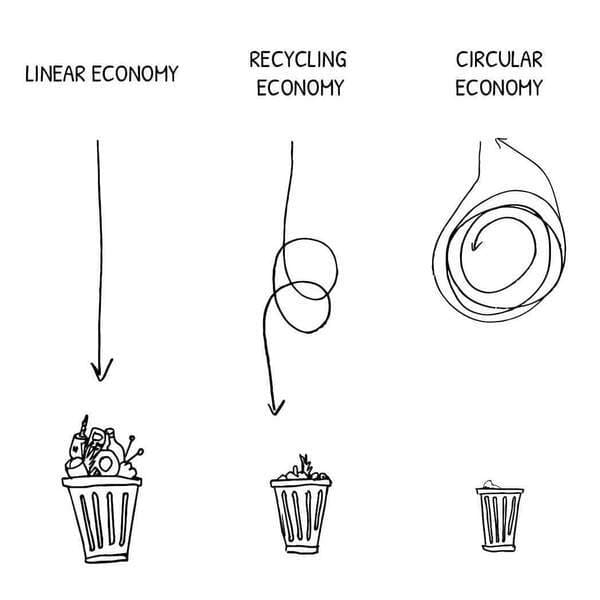
Source: Impact Hub Berlin (found on Verso) [9]
The absolute goal is to replace the "take-make-throw-away" principle of the current linear economy and to expand the already established principles of a recycling economy. In other words, the transformation away from the consumer and especially throwaway society that, historically speaking, has only recently been established (since around 1945).
A Brief History of the Circular Economy
A widespread misconception is that the Circular Economy is something fundamentally new, which is often presented as a utopia. From today's perspective, it may seem that way. But the Circular Economy is nothing new or even utopian. Essentially, it is pure retrotopia, because it is a reversal of the completely out-of-control and perverse consumer and throwaway society of the last 80 years to an economic system that uses principles that have already existed in human history. Because what we understand today as the Circular Economy was, historically speaking, the gold standard for successful economic activity for thousands of years. [1]
Deschenplecker, Humpler, Ruzen, Lepper, Schuhruzsen, Scheidenbusser, Altwender, Fürkeufflin (Take this, dear automatic translation service from even). What? Never heard of them? These are all repair and second-hand professions from the Middle Ages. These professional groups appear in the wealth tax lists of the city of Frankfurt in the 15th century. And only wealthy people paid taxes at that time. [1]
People repaired what broke, used goods markets flourished (product recycling), worn-out products were disassembled into their individual parts and reused individually (material recycling), and of course recycling and reuse of "waste" was a natural part of economic activity. [1]
Throwaway societies are therefore, historically speaking, short-term exceptions.
Let's jump to the present.
Resource Scarcity on a Limited Planet
In just 50 years, global material consumption has almost quadrupled – and thus faster than the population. When the Club of Rome's report "Limits to Growth" was published in 1972, the world consumed 28.6 billion tons. By 2000, this figure had risen to 54.9 billion tons, and in 2019 it exceeded the 100-billion-ton mark. The rapid increase in consumption is accompanied by rising waste volumes: And material consumption could rise to 170 to 184 billion tons by 2050 if everything continues as before, according to various forecasts. [2]
Info: According to climate researchers, the maximum annual stress limit of our planet is 50 billion tons. We have exceeded this for several decades. We even celebrate this annually with the so-called "Earth Overshoot Day"!
We "recycle" (more on this later) only 7.2% of our consumer goods. This means that almost 93% of what we extract from the earth to meet our needs and desires is thrown away and wasted. This is our throwaway society in practice. A massive circularity gap. [2] Or to put it the other way around: Only 7.2% flows back into our economy. And the terrible thing about this is that this rate is falling: In 2018, the rate was still 9.1%, in 2020 it was only 8.6%. [2]
Non-renewable natural resources do not renew themselves. Captain Obvious on this: "Hence the name!" This category includes primarily fossil fuels (such as natural gas, petroleum, and coal), minerals, and metal ores. The use of these non-renewable resources is linear because we can only use them once. At the current growth rate of using these non-renewable resources, these products/services will soon disappear. Nevertheless, the global economy still depends largely on these non-renewable resources.
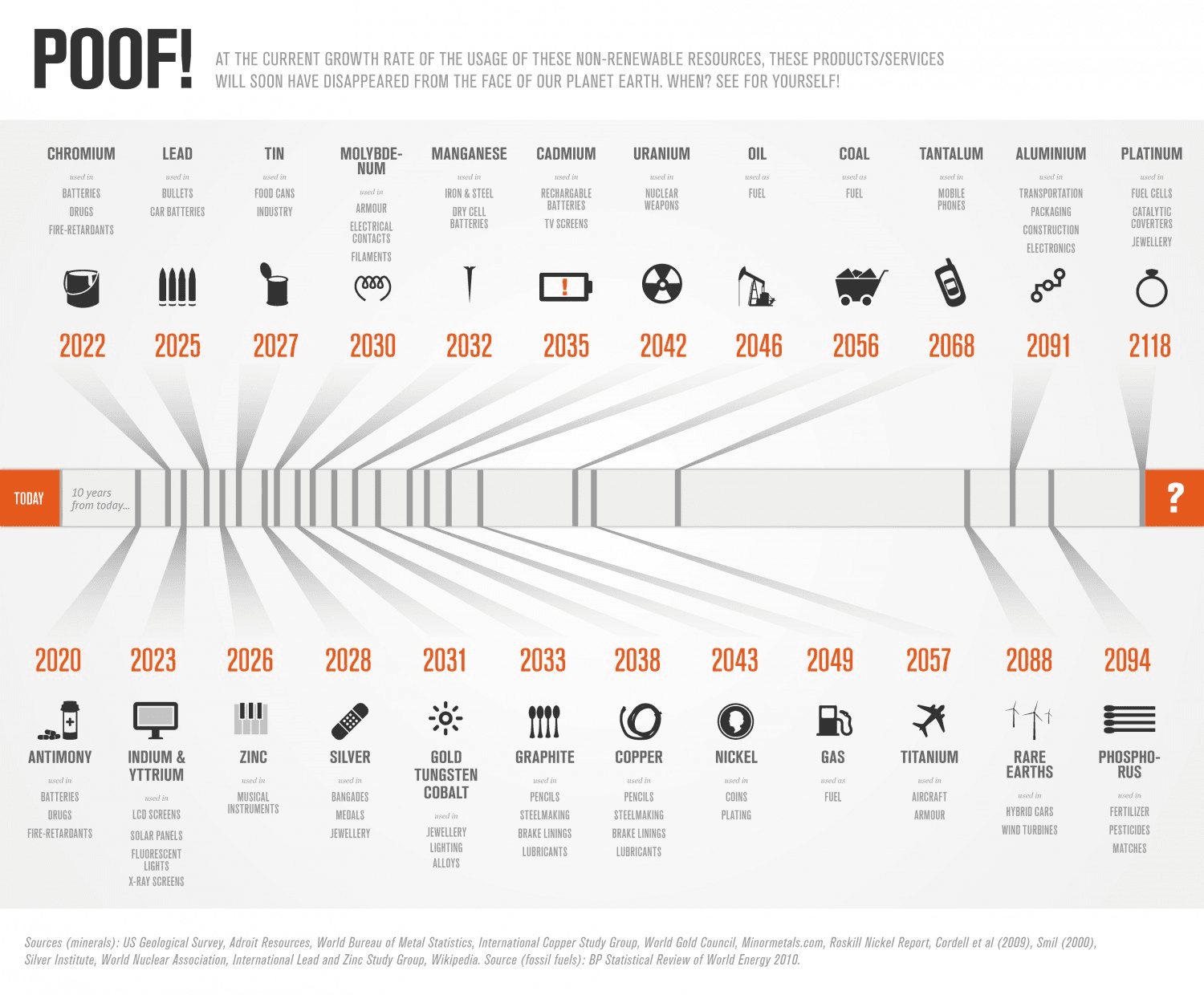
Source: visual.ly [3]
I will address this topic more intensively separately in its own

Did you find this article helpful?
Sustainability and Logistics – Circular Economy and Resilience
Blog post 2 of 2: Those who keep things in circles get through crises better than those who constantly hope for resupply.
Sustainability and Logistics – A (Beginner's) Practical Guide to Circular Economy for Logistics
The future of logistics is no longer a straight path — it's a circle. This practical guide helps you take your first steps into the loop.

Nachhaltigkeit und Logistik - Die Circular Economy und Reverse Logistics
Re-Re-Reverse when the economy says “Bo’ selecta”!
Sustainability and Logistics - Logistics as the Engine of the Circular Economy?!
The supply chain in a circle. What opportunities does this create? And what does it take to get there?