


Part 1 of 2: Sustainability and Logistics – LCA + Eco-Design = Innovation
Blog post 1 of 2: LCA, PCR and EPD. PCF, ISO and GWP. LiDS, CCF and DPP. Circular and Ecodesign oh my!
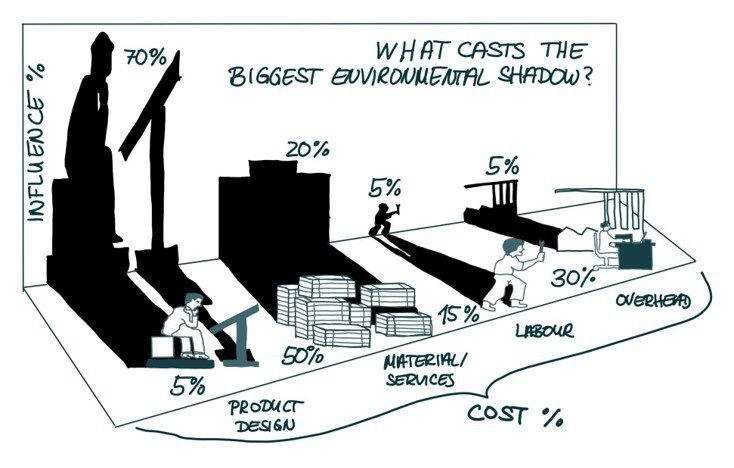
OK. I admit: a rather contrived hook in the subtitle. But hey: now you've got an earworm. Thank me later. This two-part blog post series will focus on my favorite formula. Expanded a bit, it reads: LCA + Eco-Design / Circular Design / Modular Design = Innovation. "Phew" and "Whut?" I hear you sigh. What kind of formula is that supposed to be? Easy does it. It sounds drier than it is. Especially when you keep in mind that there are hard-nosed economic realities behind it. It's about efficiencies and cost savings, the holy grail of every CFO circle. Cash Rules Everything Around Me! C.R.E.A.M., get the money! Dollar, dollar bill y'all.
But: "Why does this text even exist? And why should I even read through it?" – Legitimate questions. The topic sounds niche, unwieldy and above all unpopular. "A customer wants a PCF from us. Among other things, for their reporting. How do I get these values? Oh: LCA. Then let's do it." Does that also sound familiar? From my perspective, especially in logistics, pretty much all companies stop right here: namely shortly after determining the PCF or after creating the EPD through the LCA (if your head is spinning and you don't know what that is: don't worry, you'll learn that in this text). Goal: satisfy customer requirement.
But the crazy thing is that this is actually only half the journey. If we only provide customers with the results from an LCA in the form of the PCF, then we're leaving a hell of a lot of potential on the table. Because the second half of the journey is about naked economics: efficiencies and cost savings. Normally, a few finance-savvy controllers and CFOs should kneel down right now and mumble some Latin verses to spherical music: "COST REDUCTION!". Hallelujah. [based on 6]
Disclaimer and tip: Due to the complexity of the topic, I decided to split the blog post into two parts:
- Fundamentals: Explanations and definitions
- Formula: LCA + Eco-Design / Circular Design / Modular Design = Innovation
In this first part, I will therefore define the components of the formula from front to back and explain the different terminology in the context of LCA. So there will be many paragraphs and words that explain LCA, EPD, PCR, PCF, etc. So if you're already familiar with this, click on the second part of the blog post series.
So let's get started...
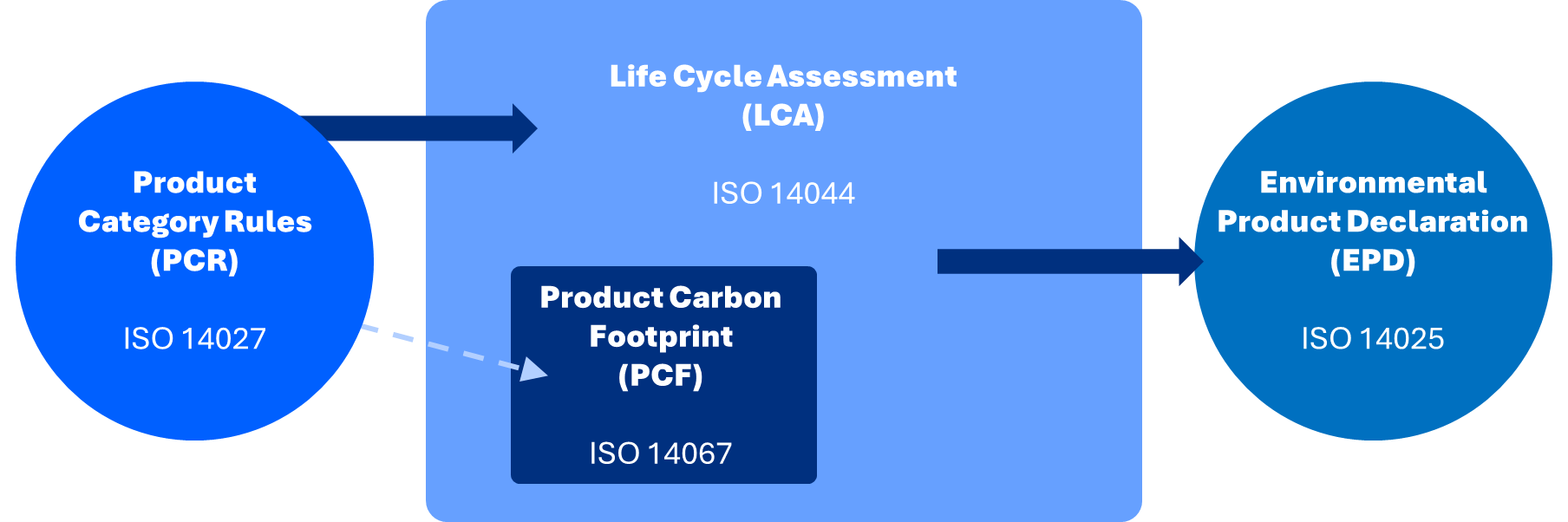
But where and how do we begin? *rubbing nose like Vicky* I've got it. Always best with a diagram:
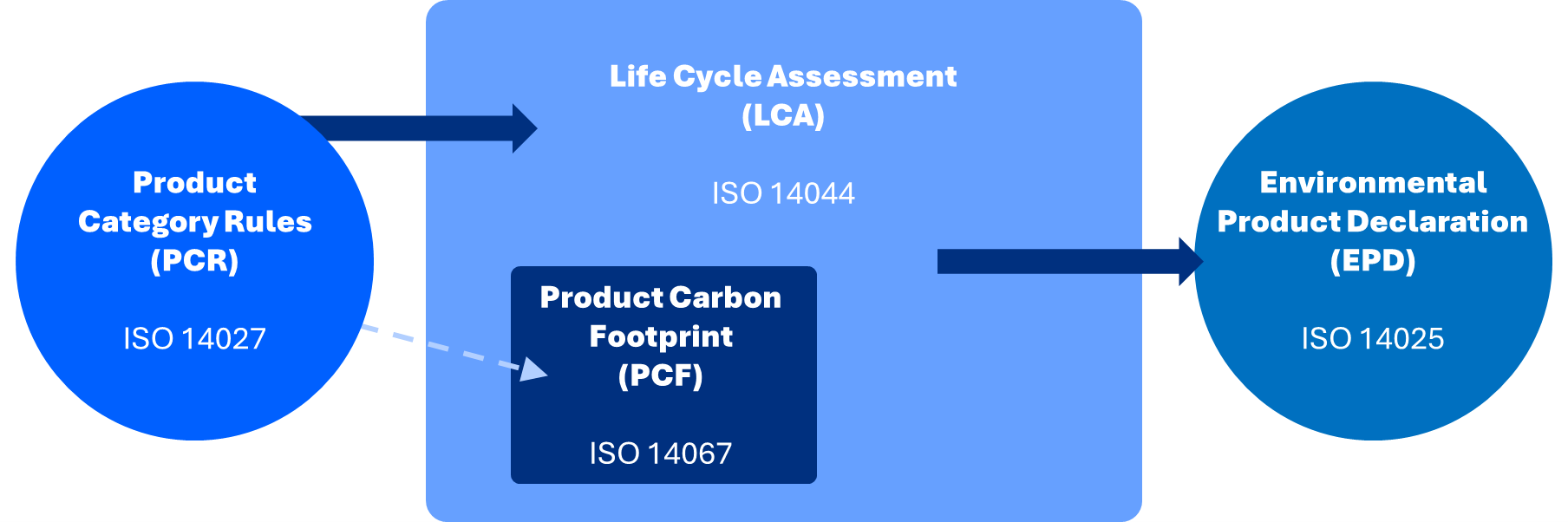
Source: Own representation based on VDMA (2025)
OK, we already have a rough classification of the terminology along with the associated ISO standards. Let's proceed from the middle in the following way:
- LCA (Life-Cycle Assessment)
- EPD (Environmental Product Declaration)
- PCR (Product Category Rule)
- CCF (Corporate Carbon Footprint) and PCF (Product Carbon Footprint)
So what exactly is an LCA?
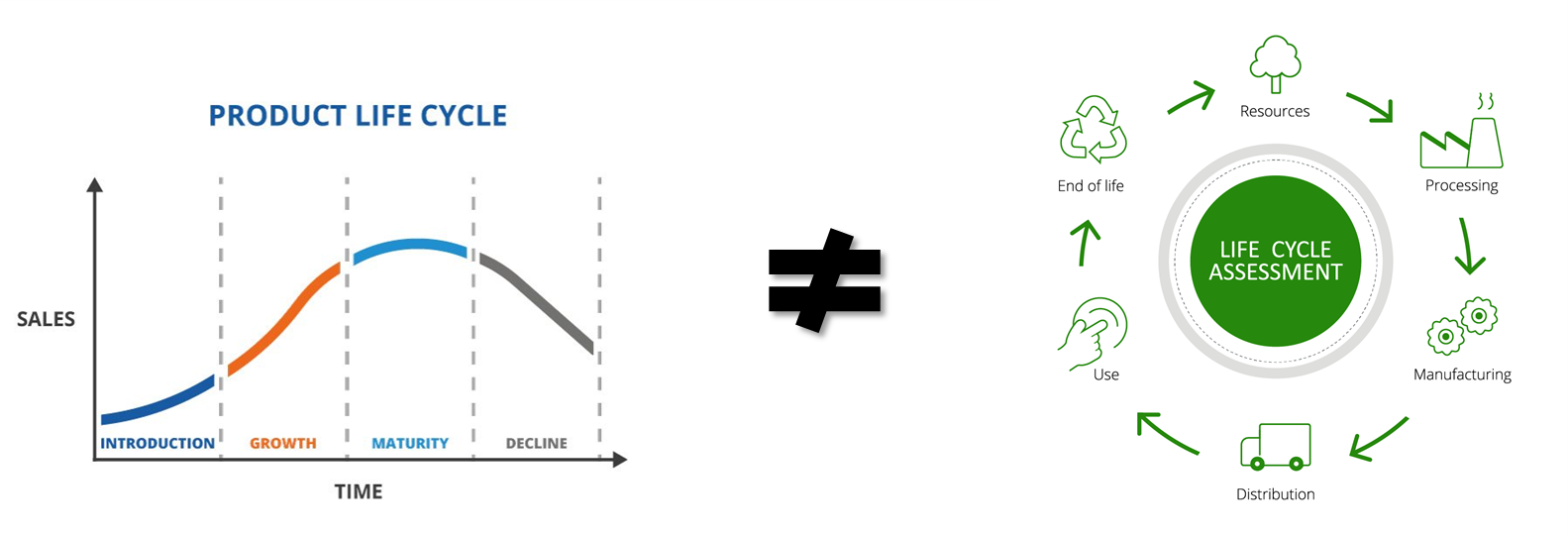
First of all, it's important to separate the Product Life Cycle from the Life-Cycle Assessment. These are two different things.
Source: TWI [1] / Talent [2]
The product life cycle describes the growth and decline phases that a product goes through between its introduction to the consumer and its discontinuation. The LCA is both a framework and a method for assessing the environmental impacts of a system or of a product, process or service throughout its entire life cycle.
Unlike the carbon footprint, which only considers climate change, the LCA is a multi-criteria assessment that quantifies many environmental impacts such as water footprint, (eco-)toxicity, acidification, energy consumption, greenhouse gas emissions and (accordingly, of course) carbon footprint of the product (the so-called PCF; more on that later), etc.
This life cycle typically includes several phases, including raw material extraction, manufacturing, transportation, use, maintenance, recycling and disposal, where all relevant material and energy flows are considered. And these phases in turn can be classified into different LCA concepts:
- Cradle-to-Gate
- Cradle-to-Grave
- Cradle-to-Cradle
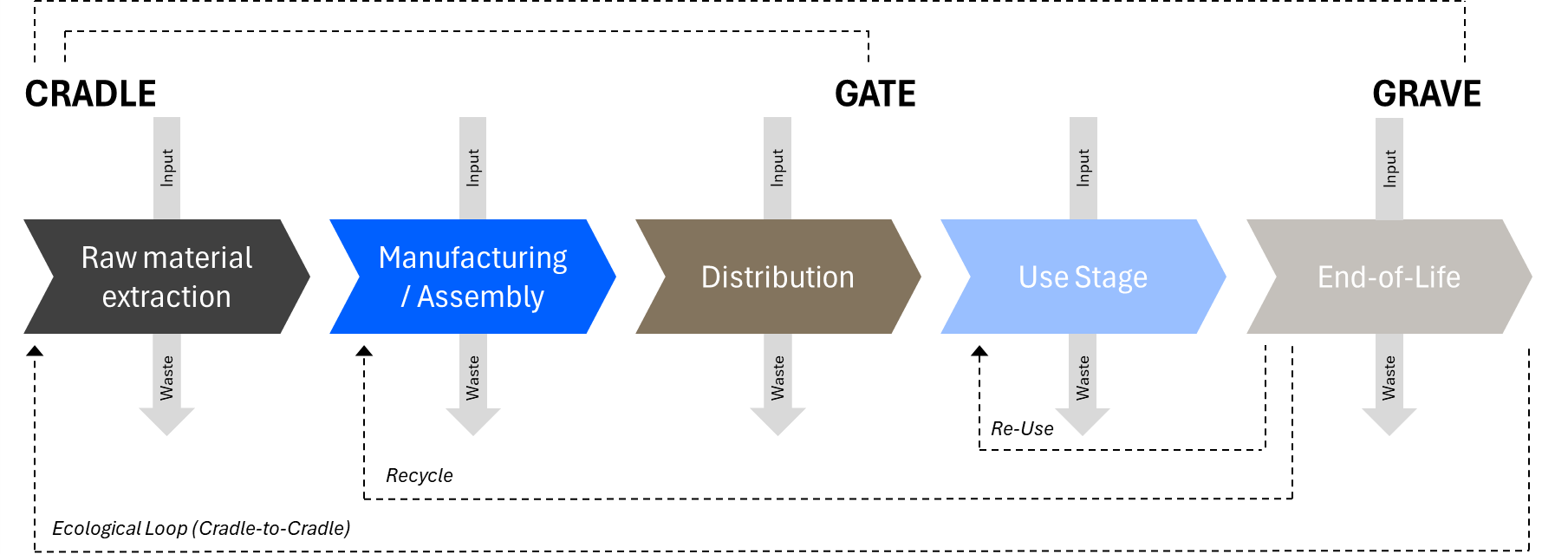
Source: Own representation based on CarbonBetter [3]
LCA: Cradle-to-Gate
This assessment focuses exclusively on the phases from raw material extraction to completion and delivery of the product - i.e. when the product leaves the factory (=Gate). Product use and disposal are not considered. Therefore, this method is particularly useful for manufacturers who want to optimize their production processes and improve the sustainability of their production. [4]
- Benefit: Often used for EPDs (see below) because manufacturers usually only have influence up to their factory.
- Example: LCA for a robot - only what occurs up to delivery of the robot is considered.
LCA: Cradle-to-Grave
This is the most common form of LCA. It assesses the environmental impacts from raw material extraction to product disposal (=Grave). Thus, Cradle-to-Grave extends the accounting of the Cradle-to-Gate approach by the "Use Stage" factor and End-of-Life. So this approach reveals the total environmental costs, but may not adequately consider the benefits of recycling or reusing materials. The Cradle-to-Cradle approach (see below) does that instead. [4]
- Benefit: Complete form, provides a comprehensive picture of environmental impacts.
- Example: LCA for a robot: manufacturing, transportation, use, and recycling or disposal are considered.
LCA: Cradle-to-Cradle (C2C)
Cradle-to-Cradle goes one step further and pursues a circular approach in the spirit of the Circular Economy. The C2C approach envisions a product life cycle in which waste is avoided through design and products are either reused or recycled indefinitely, rather than ending with disposal. Cradle-to-Cradle is thus the gold standard. [4]
- Benefit: Strong in the sustainability discussion as it aims at closed material loops.
- Example: LCA for a robot - which can be completely recycled at the end and reprocessed into a new robot.
The ISO standards that govern LCA are primarily ISO 14040 and ISO 14044. ISO 14040 describes basic principles, objectives and the framework for an LCA (What

Did you find this article helpful?
Part 2 of 2: Sustainability and Logistics – LCA + Eco-Design = Innovation
Blog post 2 of 2: Just doing LCAs to deliver PCFs is like reading a thermometer without adjusting the heating.

Sustainability and Logistics - On Circular Economy and Resilience
Blog post 1 of 2: What resilience really means (and what it doesn't): Robustness, antifragility, and efficiency compared.

Nachhaltigkeit und Logistik - Die Circular Economy und Reverse Logistics
Re-Re-Reverse when the economy says “Bo’ selecta”!

Is Less More? Packaging Between Regulation and Practice - with Max Haschke
On the growing demands placed on packaging, sustainability, and the balancing act between regulation and practice.