


Part 2 of 2: Sustainability and Logistics – LCA + Eco-Design = Innovation
Blog post 2 of 2: Just doing LCAs to deliver PCFs is like reading a thermometer without adjusting the heating.
In a nutshell: "You can't improve what you don't measure". You couldn't start with a more overused, motivational-poster kind of quote, right? But hey – there's so much truth packed into that sentence. And it's also critically important for the formula "LCA + Eco-Design / Circular Design / Modular Design = Innovation" [1]. Whether it's product design or product redesign – it doesn't matter. A LCA should always come first. That's the "measure" part of the quote. As I outlined in part one, most companies unfortunately stop after successfully completing an LCA. It remains a mere box-ticking exercise: determine the PCF and deliver it to the customer. But if you've already measured, you might as well improve. That's exactly what this second installment of the blog post series is about.
Disclaimer and tip: Due to the complexity of the topic, I decided to split this blog post into two parts:
- Part 1: Fundamentals: Explanations and Definitions
- Part 2: The formula (this post): LCA + Eco-Design / Circular Design / Modular Design = Innovation
In part one, I covered the individual components of the formula. If you need to catch up or are simply curious, follow this link. This second part focuses on the potential of the formula – although I should warn you upfront that we can't avoid a few additional definitions along the way. Soooooorry!
Here we go!
Product design is the key to sustainable, more cost-effective products
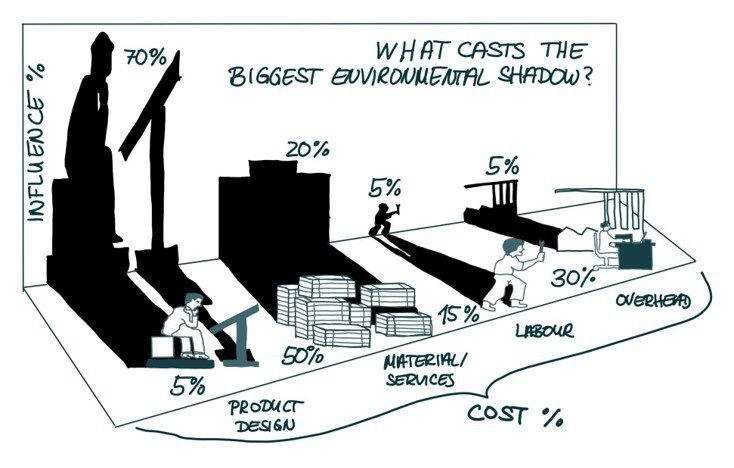
The environmental impact of a product is largely determined during the early design phase. Designers and engineers therefore have the greatest influence on a sustainable future, on efficiency gains and cost savings – and, indirectly, on the sustainability of a product. The well-known formula on this point:
"Around 70–80% of the environmental impacts associated with a product can already be avoided during the development and design phase." Ellen MacArthur Foundation, 2022

Wait – how? And: that much? That's probably what some of you are wondering right now. The design phase determines whether a product becomes a "one-hit wonder" with a short lifespan or a durable, efficient long-term companion. Lou Bega or Scooter. OK, a completely weird comparison. Let's move on as if nothing happened. The point is: 70–80% of a product's future environmental impact is baked in as a consequence of early design decisions – and can therefore be avoided most cost-effectively at that very stage.
There is a correlation between the price and quality of a product and its environmental impact. Note: this correlation is not linear – it depends heavily on the design approach.
Because: cheap often means costly for the environment – and therefore for society. So far, so clear. Luxury items and very expensive premium products, on the other hand, can be ecologically better, but equally more harmful to the environment if, for example, they are unnecessarily resource-intensive due to luxury features. This means that price alone cannot be used to derive a 1:1 correlation – what matters is how durable, efficient, repairable and recyclable a product is. And that, in turn, is a fundamental question in product design.
Rule of thumb: If we design high-quality products, it is ultimately more economically sensible when viewed from a holistic perspective. Unfortunately, this does not mean that a higher-quality product will automatically be more successful in the market, even though both the vendor/manufacturer side and the consumer/buyer side would benefit. Because these products are not necessarily cheaper at the point of sale (although examples do exist), but very often prove more cost-effective when viewed from a systemic, whole-lifecycle perspective. Before anyone raises a finger: I am deliberately setting aside the societal question of whether the less affluent part of society has access to cheaper products and cannot afford the quality equivalent.
OK, product design sounds more like B2C and the things we buy online or in stores. And yes, that is of course where the biggest lever lies in a consumer and throwaway society. But products are also designed in logistics (i.e. B2B): machines for automation, packaging for transport and storage, trucks, forklifts, pallet trucks – even services as such, or software, are designed. What I mean is: product design is equally decisive in and for logistics.
Speaking of design: before we dive into the formula itself, we need to briefly look at the design principles and approaches it contains, and distinguish them from one another. It should be noted at this point that these design principles cannot be clearly separated from each other. The overlaps are simply too significant for them to stand as entirely independent principles. In practice, I keep things simple and treat the three as a triptych sitting side by side.
Ecodesign
Ecodesign (also known as "ecological design") is a design approach for products, services or systems in which environmental aspects across the entire lifecycle are considered alongside the usual criteria such as functionality, cost and aesthetics. This means: from the very moment a product is conceived, the aim is to make it as resource-efficient, durable, repairable, energy-efficient and recyclable as possible.
Instead of "cheap, fast, broken", ecodesign means:
- Choosing materials that don't become hazardous waste after the first use,
- building devices so they can be repaired without needing an engineering degree or three extra hands,
- and designing things so that more can be recycled at the end of their life than just the box they were delivered in.
The EU has even

Did you find this article helpful?
Part 1 of 2: Sustainability and Logistics – LCA + Eco-Design = Innovation
Blog post 1 of 2: LCA, PCR and EPD. PCF, ISO and GWP. LiDS, CCF and DPP. Circular and Ecodesign oh my!

Sustainability and Logistics - On Circular Economy and Resilience
Blog post 1 of 2: What resilience really means (and what it doesn't): Robustness, antifragility, and efficiency compared.

Nachhaltigkeit und Logistik - Die Circular Economy und Reverse Logistics
Re-Re-Reverse when the economy says “Bo’ selecta”!

Is Less More? Packaging Between Regulation and Practice - with Max Haschke
On the growing demands placed on packaging, sustainability, and the balancing act between regulation and practice.