


Sustainability and Logistics – CO2 Bullshit Bingo: An Attempt at Clarification
Blog post 2 of 4: Global warming and the CO2 bathtub.

In a nutshell: In the first part of this 4-part blog post series, I covered the greenhouse effect and the share of human activities in that effect. Now, in the second part, we continue with the fundamentals — this time looking at climate change, i.e. global warming, and the so-called CO2 bathtub. I'll admit this is well-trodden territory as a topic and really shouldn't be questioned anymore in 2025. But it seems to me that in recent years we have turned away from scientific consensus. "But the Chinese…" or "Germany is only responsible for 2% of global emissions. And we're supposed to save the world?" Who hasn't heard these arguments? I mentioned it in the first part and want to repeat it here: No meaningful discourse is possible when we spend more time debating the existence of facts than their significance. People have always held different opinions. Today they have different facts. But without a shared reality, no effective collective decisions can be made. So pack your rubber duck — we're heading into the bathtub, among other things.
Info: Due to the complexity of the topic, I have decided to split the blog post into four parts:
- Post 1: Greenhouse gases and the greenhouse effect
- Post 2: Climate change, global warming and the CO2 bathtub
- Post 3: CO2 Bullshit Bingo Part 1 (Level: Individual)
- Post 4: CO2 Bullshit Bingo Part 2 (Level: Companies and Nations)
This text feels a little odd to write. It's about climate science. As such, all the facts and most of the descriptions are based on the sources. I've added or reworded things here and there, of course, but essentially I've just pieced together passages of text. So if you think this text is brilliant: kudos to the sources.
Global Warming
More greenhouse gases in the atmosphere ultimately lead, through the greenhouse effect, to higher temperatures (both absolute and on average), which in turn triggers anomalous events that are becoming more intense and more frequent. Record temperatures, heat waves, heavy rainfall, extreme weather events such as hurricanes, tornadoes, etc. We simply have more energy in the overall system. And the raw data show that these two factors are directly linked to climate change.
On 22 July 2024, the daily global average temperature reached a new record of 17.15°C. This surpasses the previous records of 17.09°C, set just one day earlier on 21 July 2024, and 17.08°C, set a year before on 6 July 2023. June 2024 was the 13th consecutive month of record-breaking global temperatures. Beyond the record itself, this is particularly remarkable because 2024 did not coincide with an El Niño warm phase. [4]
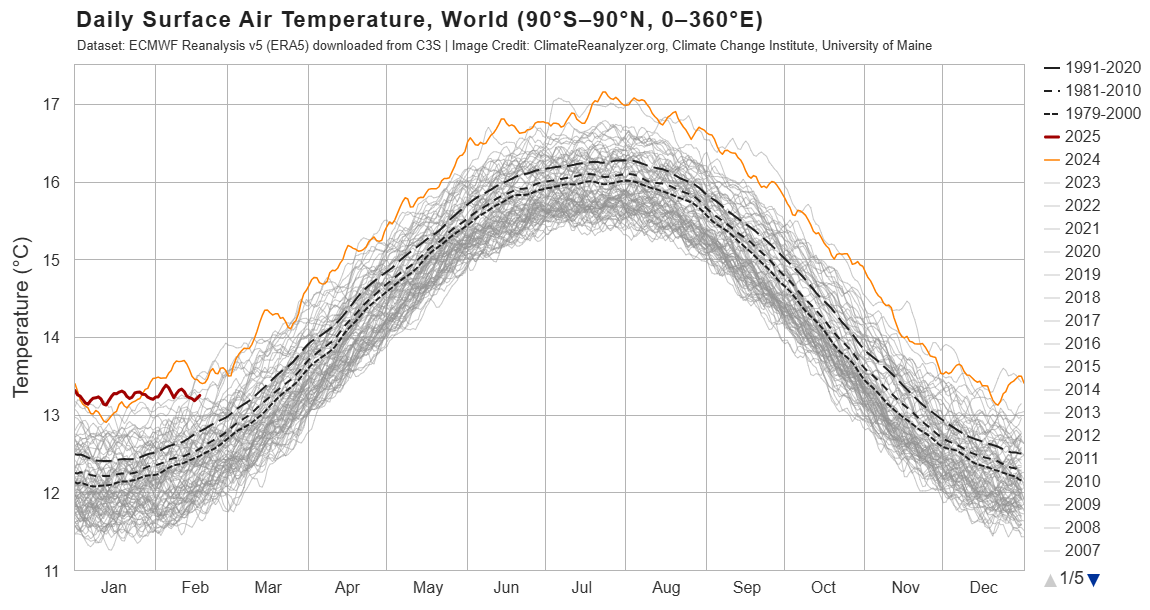
A further indication of the global warming trend is the fact that the 10 years with the highest daily average temperatures are the last 10 years, from 2015 to 2024. The orange curve in the graph above represents the year 2024.
The last decade was the warmest in 125,000 years. Back then, the warmer temperatures were caused by slow, multi-year fluctuations in Earth's orbit (Milankovitch cycles). We are warming at a rate not seen in at least 2,000 years. It is also clear that the rate of warming in recent decades has been much faster than the average rate since the beginning of the 20th century. [2]
The rise of approximately 1.5°C in average global surface temperature since the pre-industrial era may seem numerically small, but it represents a significant increase in stored heat. This additional heat leads to regional and seasonal temperature extremes, reduces snow cover and sea ice, intensifies heavy rainfall, and alters the habitats of plants and animals — some becoming larger, others smaller. Weather events are becoming more extreme and more frequent!
By the way: The global warming caused by human greenhouse gas emissions is partly masked by fine particulate pollution (sunlight-reflecting atmospheric particles such as sulfur dioxide from cars and factories). These have a significant cooling effect on the planet of approximately 0.4°C. [3]
The CO2 Bathtub, or the Question: How Much Are We Still Allowed to Emit?
This brings us to the question of how much CO2 humanity is still allowed to release into the atmosphere. The limit(s) we need to set have been determined by the Intergovernmental Panel on Climate Change. These are the different scenarios, and the international community has committed to the 1.5°C and 2°C targets respectively.
Now let's imagine a bathtub:
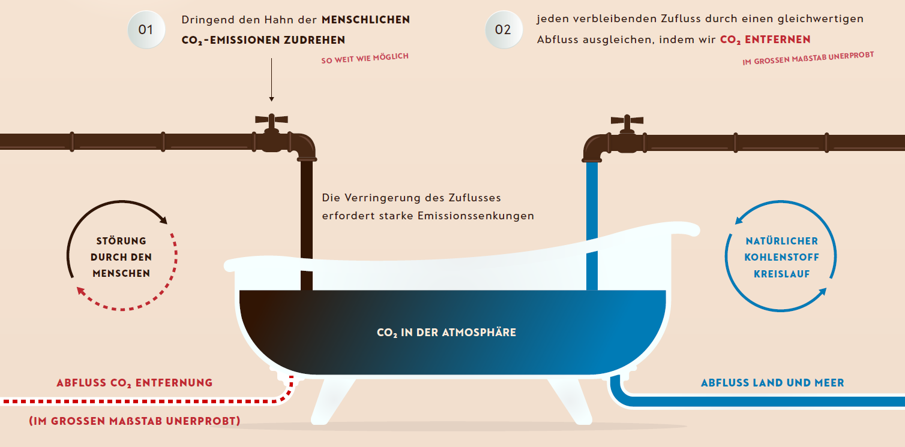
Before ~1750, at the starting point of the Industrial Revolution, the water level was always roughly in equilibrium. With the Industrial Revolution and the associated increase in greenhouse gas emissions, more water began flowing into the bathtub than could drain out. The water level in the bathtub therefore began to rise. [3]
To put the annual CO2 production in simplified figures (from 2021): [5]
792.4 gigatons of carbon from nature
- 507.6 gigatons from land & vegetation
- 284.8 gigatons from the oceans
- 40.4 gigatons of carbon from human activities
- 34.5 gigatons from the combustion of fossil fuels & cement production
- 5.9 gigatons from changes in land use (e.g. deforestation)
- 832.8 gigatons of carbon
40.4 out of 832.8 gigatons of CO2 amounts to approximately 5%. That is also the human share of annual CO2 turnover. This seems small compared to the enormous volumes cycled through the global carbon cycle over the course of a year. The problem with our emissions, however, is not the quantity itself, but that these emissions are impacting a system with a fragile equilibrium and are durably disrupting it. [5]
What matters is how much CO2 is reabsorbed from the atmosphere each year. In fact, nature on land absorbs 8

Did you find this article helpful?

Technological Openness and Its Limits
On the challenges of the mobility transition between market logic, planning certainty, and political responsibility.

What Employees in Logistics Really Want
About benefits that go far beyond salary – and become the key to motivation and retention.

Employee Benefits in Logistics
Which employee benefits beyond salary really make a difference.

Successful Complaints Management in the Logistics Industry
From suggestion boxes to trusted representatives to awareness teams.