


Technological Openness and Its Limits
On the challenges of the mobility transition between market logic, planning certainty, and political responsibility.

In a nutshell: We need more technological openness in Germany! Repeated like a mantra in print and social media, wielded as a blanket argument in every political talk show and at countless events. Usually thrown into the blender in the same breath as cutting red tape. Topped off with the cherry on top: "Let the market decide!" Done. The applause recipe is ready. Clap-bait, so to speak. Because deep down, everyone can get behind it, right? OR CAN THEY? I have to admit, I have issues with this mainstream demand. And that's what I want to explore in this commentary.
I always flinch when the blanket demand for technological openness washes over me. Not because I think it's fundamentally wrong. I consider technological openness enormously important. But more on that later. What leaves me questioning in this context – and has for some time now – is the simultaneous demand for greater planning certainty. How do those two go together? Technological openness and planning certainty. That's a real tension. Let's take a closer look.
Disclaimer: I will approach the demand for greater technological openness based on my experience in and around logistics. That means: conversations, interviews, podcasts, keynotes, panel discussions. Anecdotal evidence, in other words. At the same time, I'm mixing these experiences with statements from (federal) politics and various electoral and party platforms. Nevertheless, I believe that these experiences – and the commentary based on them – are adaptable to many other industries.
Technological Openness – I'm in favor.
Technological openness can mean many things. For instance, it can be understood as a countermodel to prohibition. Debates around nuclear energy are a good example here. The general demand for openness has grown – and continues to grow – on conservative-neoliberal soil, resonating well beyond that milieu. Part of the reason the narrative of technological openness is carried through every congregation like a monstrance is probably the associated fear of bans and restrictions on freedom. Unfortunately, it is all too often invoked without nuance. That's terrain worth carefully dissecting and contextualizing – and perhaps I'll do that in a future commentary.
In this commentary, I want to focus on the dimension of technological openness that cultivates a different field: namely, the invisible hand of the market, which – given maximum technological openness – steers the "best" available technology toward victory in an evolutionary sense. Unfortunately, this comes with a tension I want to illustrate through a specific example that also prompted me to write this commentary: the mobility transition in transport logistics.
Electric or hydrogen? HVO? Which is it? Or all of them? Some combination? The perennial question that has been hovering over transport logistics for years. What the current state of play looks like, which technologies have advantages and disadvantages, which will "win the race" – that's not what this is about. Sorry. We're looking at how the invisible hand of the market actually operates, and what implications that has.
Because there are different perspectives on this. The view of:
- OEMs,
- industry leaders, and
- logistics service providers / freight forwarders.
From an OEM perspective (Scania, Daimler, Volvo / Renault, etc.) – meaning the companies that ultimately research, develop, and bring new drive technologies for trucks to market – technological openness is absolutely right and important up to a certain point. At the end of the day, that's what innovation is and delivers. But it also costs money and requires courage. In the early phase of technological openness, it fundamentally comes down to answering the question: What does the world of the future look like, and what is our response to it (from a corporate perspective)? That is the heart of forward-thinking and innovation. Companies whose goal it is – importantly: not just on paper, but in lived practice – to remain relevant in a future world dedicate themselves precisely to this challenge.
From an industry leader perspective (in logistics, that means DHL, DB Schenker, DSV, etc.) – meaning companies that hold a leading position in their industry (in terms of revenue and headcount) – technological openness is likewise absolutely right and important up to a certain point. And for exactly the same reason as for the OEMs. They want to maintain and defend their market power.
What OEMs and industry leaders have in common: they also have the financial resources and human capital. That means they have both a certain financial backbone and the capacity and (largely) the capabilities that encourage and enable experimentation and exploration in the spirit of technological openness.
In contrast, there are an incredible number of "hidden champions of logistics" and smaller logistics service providers / freight forwarders that carry out an absolutely significant share of the daily work on Germany's and Europe's roads, rails, airways, and sea lanes – and that operate an average fleet of 10 trucks across Germany as a whole. So the AI tells me. And that's across approximately 15,000 freight forwarding companies in Germany. That figure comes from Statista (for the year 2023). These companies also have an interest in remaining relevant in the future. But…
Beyond the fact that logistics has always been a margin-driven industry and – as a result – chronically tight on cash, freight forwarding companies do not have a FC Bayern-style fixed-deposit account built up over years that would readily enable investment in a possible future. The ratio of available capital to impact is naturally far greater than for industry leaders. Every major investment is essentially turned over ten times and must be rock-solid, since otherwise it could have a profound effect. Misallocated investments at this level lead directly to the worst-case scenario. And that brings us squarely to the topic of planning certainty.
Because how do you communicate to such a company that it should invest with deep risk appetite into an as-yet-undecided future – in the name of technological openness? And potentially on two or more tracks simultaneously, as OEMs and industry leaders can do. Sure. All companies need planning certainty, but smaller companies generally need more of it, because the ratio of risk to impact is far greater. They cannot absorb risks at this level. Accordingly, the "business case" must be solid and cannot be subject to fluctuations. And that over years. Or more precisely: the risk must be manageable. Ideally in a way that means the worst-case scenario has no impact, or the best possible

Did you find this article helpful?

What Employees in Logistics Really Want
About benefits that go far beyond salary – and become the key to motivation and retention.

Employee Benefits in Logistics
Which employee benefits beyond salary really make a difference.

Leadership in Modern Logistics
Living and passing on growth – an interview with Lorena Garcia from AUTODOC.
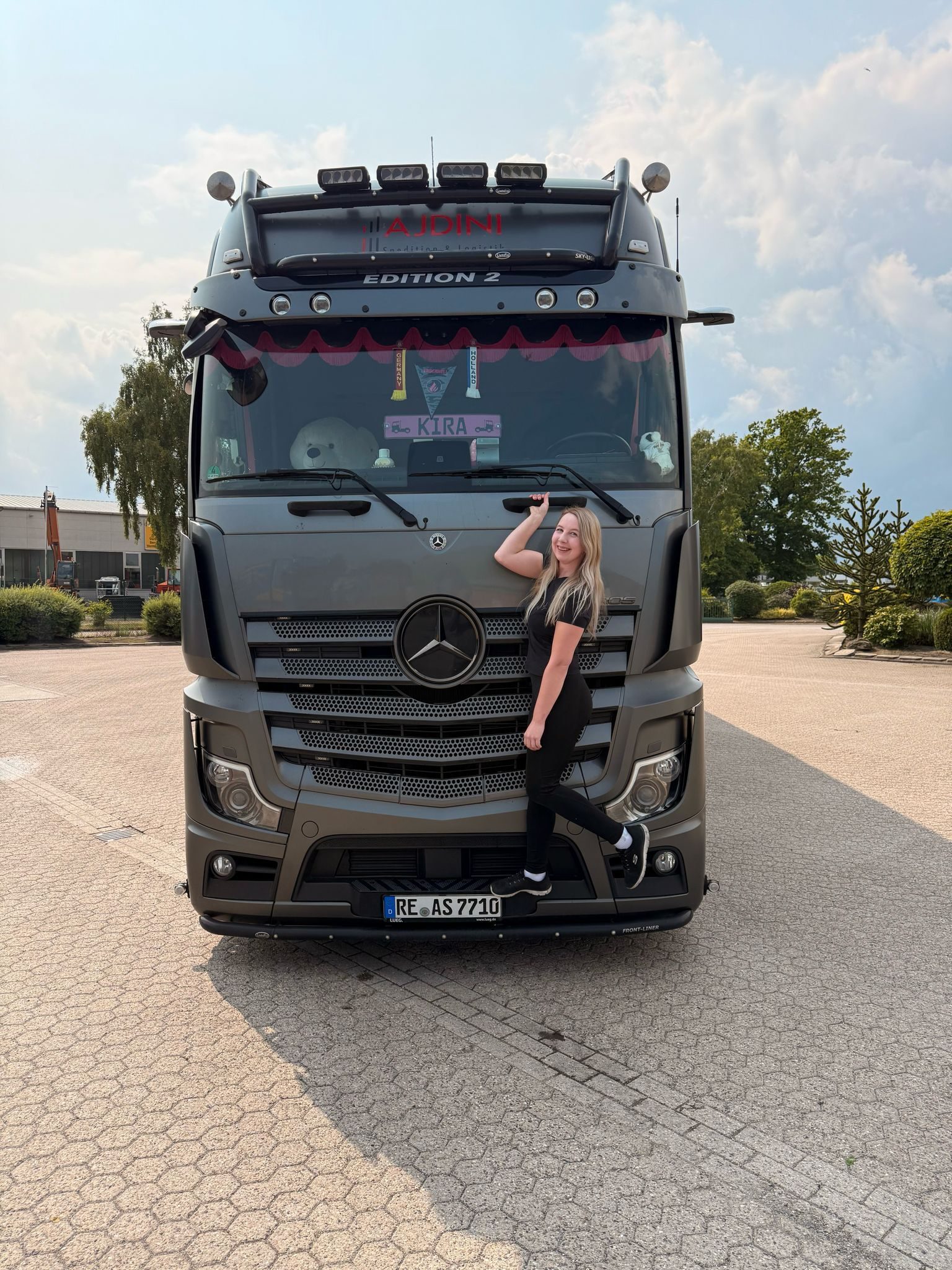
Blonde, 1.60m tall, woman at the wheel – Kira breaks the stereotype
Insights into the life of a long-haul truck driver: An interview with Kira Ölkers.