


Why PURELEI Prefers to Ship Its Advent Calendar In-House
Logistics Manager Sebastian Imhof talks about lessons learned, warehouse processes, external partners – and where PURELEI draws the line today.
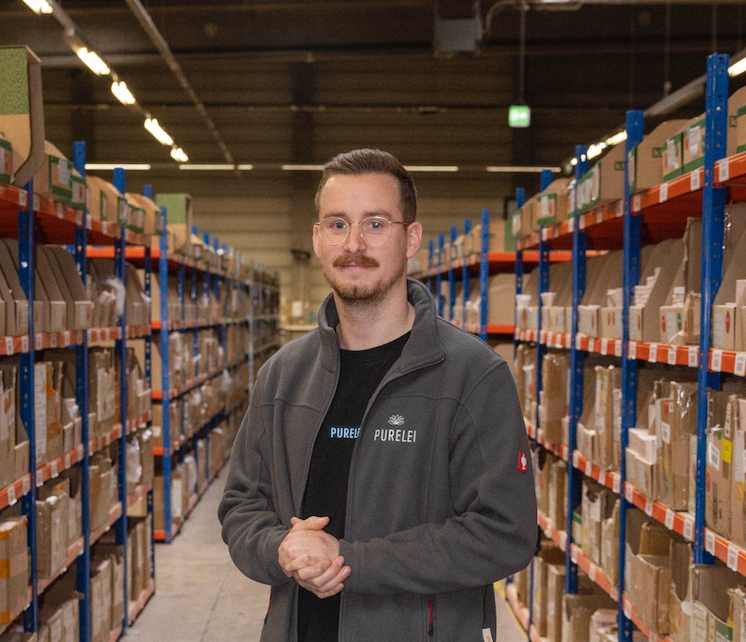
In a nutshell: After three years with an external fulfillment provider, PURELEI took back control of its advent calendar shipping in 2024 at short notice – and plans to do so again this year. In this conversation, Logistics Manager Sebastian Imhof shares what they learned from the experience, how they plan for seasonal peaks, why standardized processes matter so much – and where they still rely on external specialists.
Johanna: How does your logistics operation work overall – what do you handle in-house, and what do you outsource?
Sebastian: We handle almost everything ourselves. There are two major areas we've regularly outsourced: the Mahina Club – our monthly subscription model – and advent calendar shipping. With the Mahina Club, it depends on the month. When a sales promotion coincides with it, things get tight internally, so we hand off the shipping. Last year we did that six times – it always falls in months that are already busy.
And what exactly is in the Mahina Club?
It's a jewelry subscription. As a customer, you receive exclusive pieces every month – always a necklace, sometimes with earrings or a bracelet, depending on what we've planned. You can subscribe monthly or sign up for three, six, or twelve months at a time.
You're shipping the advent calendar in-house again now – how did that come about?
It's our biggest project of the year. We plan for around 100,000 units. Five years ago we handled it entirely ourselves, but the volumes were significantly lower back then. For the past two years, shipping ran through a service provider – but it never really worked well. One time items weren't shipped correctly, then they were shipped twice because there was no clear process behind it. Last year something bigger went wrong again – and we said: we can't keep going like this. I think that was at the beginning of September. So we made a last-minute decision to take the shipping back in-house.
And how did you actually pull that off – logistically speaking?
The calendar is assembled by a contract packager and then shipped to us. Most orders contain just a single calendar. We store them on pallets – 126 units per pallet – and can print shipping labels in bulk. It goes really quickly. We know exactly how picking and packing works, and as a result last year went really well. That's why we're doing it in-house again this year.
Did you consider simply switching to a different provider?
In theory, yes – but realistically that wasn't an option. You don't just find a partner who can take on a project of that scale at short notice. Integration alone often takes many weeks. There simply wasn't time for that. In our warehouse, everything is in place – the systems are there, the staff are trained – we could get started right away.
Is in-house shipping now the permanent solution going forward?
Definitely for this year. We've seen that it works. Whether we do it permanently, we'll have to see. But it feels good to have control over such an important project back in our own hands.
Are there other processes you're currently thinking about outsourcing?
I'm in the process of handing our engraving service over to an external provider. It's performing really well and has been very well received by customers. But internally, we're limited. I set it up myself back in the day – the whole thing from scratch – but it takes up a lot of time and is technically complex. We currently only offer three fonts and a handful of engravable products. An external partner could offer much more – for example, handwritten engravings or even photo engravings. That would be a real added value for our customers.
What matters most to you internally – what do you want to focus on?
Focus. We want to do what we do really well – pick, pack, ship. Engraving is a specialist topic. If we hand that off, we can direct our energy toward the things we have under control and can execute quickly and reliably.
How do you manage seasonal peaks, especially toward the end of the year?
In Q4, we bring in additional support through temporary staffing agencies. In the past we had as many as 25 or 30 temporary workers on site at the same time. Today we need five to ten at most – if that. But it's getting harder to find good people. We plan four to six weeks ahead, run trial days, and look carefully at who fits into the team. It's a real effort every time.
You're achieving more with fewer people today – how did you manage that?
When I started here, we had 90 people working across three shifts. Today, 40 people in one shift handle the same number of orders. During peak periods, that's 8,000 to 10,000 orders a day. The difference is: in the past we ran aggressive sales promotions – discounts of up to 70% – and suddenly had 30,000 orders in a single day. Today it's much more evenly distributed. We run promotions with minimum order values and more moderate discounts. That's far easier to plan around.
What helped you the most with that?
In the past, everyone packed however they liked. Today we have fixed standards that everyone is trained on. Everyone does it the same way, everyone knows what to do. That makes us much more efficient – and we can also much better estimate how much volume is actually achievable in a day.
Have you already automated anything – or are you planning to?
A little, yes. For example, we've installed a conveyor belt at the packing stations. Staff no longer have to carry boxes away themselves – they simply place them on the belt, which then sorts them and sends them directly to the carriers. That helps enormously – it saves time and takes the strain off the team. But we don't have robots driving through the warehouse.
How flexible are your shift arrangements at the moment?
We currently work one shift – 6:00 to 14:30. We only work longer or add a Saturday shift when it's really critical, such as during advent calendar shipping or the Birthday Sale in August. But that's rare. In the past, with three shifts, we had enormous staffing costs, including shift premiums. Today we save all of that – and still achieve the same output.
How do you make decisions like the one about shipping?
I don't make those decisions alone. When we're considering whether to ship the advent calendar in-house again, for example, I discuss it with my team leads. Together we look at what's feasib

Did you find this article helpful?

"I'm building Germany's largest logistics empire"
How a young founder is rethinking logistics - with Leon Michel, CEO of fly fulfillment GmbH.

Die besten Fulfillment-Dienstleister für E-Commerce 2025 / 2026
Welche Fulfillment-Dienstleister überzeugen wirklich im E-Commerce? Unser Vergleich 2025/2026 basiert auf echten Nutzerbewertungen.

Black Friday and Its Impact on the Logistics Industry
Shopping ecstasy for some, logistical challenge for others.

From Excel Chaos to Scalable Fulfillment – Answers from the even Webinar with storelogix & Cella
Covering the most interesting questions on configuration, updates, and go-live speed.