


Sustainability and Logistics – Circular Economy and Resilience
Blog post 2 of 2: Those who keep things in circles get through crises better than those who constantly hope for resupply.
Wow. What an opening in the first part of the resilience blog post. A wild ride on the philosophical horse. For those who made it this far: Chapeau! And at the same time, the promise that it will become a tad more pragmatic and tangible. Though. Well, it can't get entirely pragmatic when it comes to resilience. The Circular Economy alone, with all its facets, use cases and opportunities, poses difficult questions for companies, and as we will see, beyond declarations of intent at a grand level, hardly anything manageable has been implemented. Although, the situation isn't quite that defeatist either.
As in nature, resilience in the Circular Economy doesn't emerge through maximum efficiency of individual elements, but through well-designed cycles, diversity and the ability to continuously renew itself. I will try to build this bridge and show how the Circular Economy leads to greater resilience and why it's worthwhile in the long run to think and act circularly.
Disclaimer and tip: Since the term "resilient" is often used for quite different characteristics, I decided to divide the blog post into two parts:
- Fundamentals: Explanations, definitions and distinctions
- The Circular Economy as a resilience strategy
The first part was about why resilience plays or will play such a central role in economic systems, supply chains and organizations, and how the concept differs from related topics like antifragility and robustness, and what relationship resilience has to efficiency. [1] In this second part, things get more concrete: Here I show how the Circular Economy not only offers ecological and economic benefits, but works quite practically as a resilience strategy – and why circular value creation is a crucial lever for more resilient systems in uncertain times.
For those who want to brush up on the Circular Economy, I recommend my previous blog post entries:
- The Circular Economy
- Logistics as the Engine of the Circular Economy?!
- The Circular Economy and Reverse Logistics
The largest resilient system is nature itself. It and the ecosystems underlying it are the epitome of resilience. Ecosystems function according to clear principles that come remarkably close to the logic of the Circular Economy. Nature therefore serves the Circular Economy not only as a source of inspiration, but as a concrete model for its design. Biomimicry at the system level, so to speak. Let's take a closer look.
By the way: Biomimicry (or biomimetics) is an innovation method that learns from nature and imitates its strategies to sustainably solve human problems in technology, design and organization by adopting principles and Solutions from organisms and ecosystems that have proven themselves over millions of years. It's about not just copying nature, but developing a deep understanding of how life works in order to create products, processes and systems that are in harmony with the Earth (example: the lotus flower effect in self-cleaning surfaces).
Ecosystems – Nature as a Model
The behavior of ecological systems can be defined by two different characteristics: resilience and stability. But how does nature do it?
Ecosystems in nature are masters of cycles. Every element, from the smallest microorganism to the largest predator, is part of a complex network that uses resources efficiently, minimizes waste and keeps the system stable overall. Plants, animals, fungi and microbes interact in food chains, material cycles and symbiotic relationships – ensuring that the ecosystem remains resilient to disturbances.
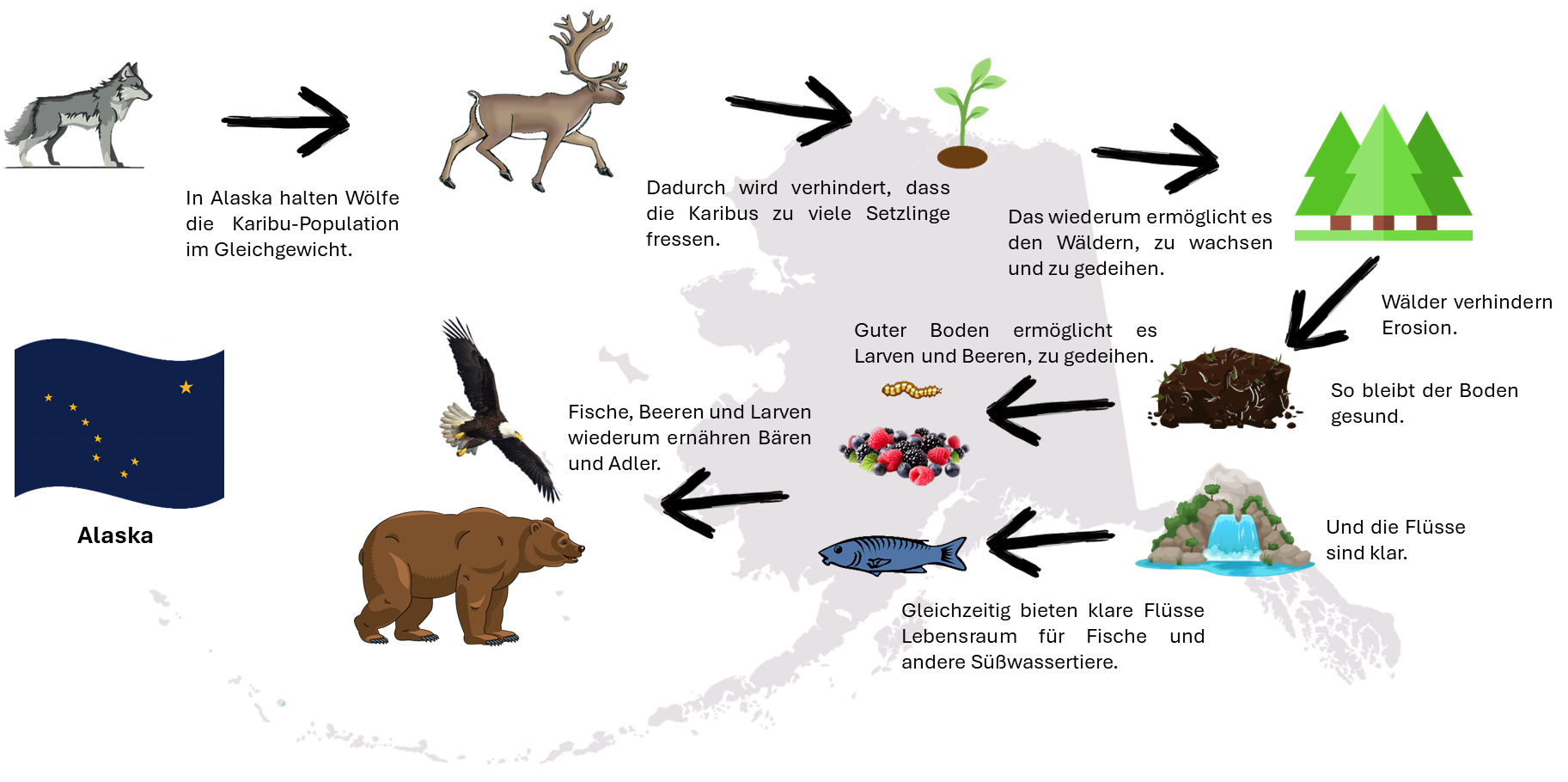
An ecosystem in balance using Alaska as an example:

Source: Own representation based on [5]
The interrelationships shown above strengthen and maintain the resilience of the ecosystem by literally nourishing the network. But this positive chain reaction can also go in the other direction. In areas where wolves have been eradicated, for example, entire ecosystems collapse: forests die off, soils erode, rivers silt up, and eagles and bears disappear. Because: Ecosystems are complex networks. They can be enormously resilient under stress, but when certain central nodes begin to fail, chain reactions run through the web of life, threatening the stability of the system.
In mature ecosystems, then, the health of the entire system is optimized through symbiotic relationships between different species. Nutrient, information and energy cycles create diverse connections throughout the system, so that one organism's metabolic products become food for another and feedback loops ensure temporary stability in a constantly changing and evolving context. [7]
Ecosystems are resilient because they exhibit the necessary diversity and numerous redundancies at different levels. The regenerative capacity of ecosystems is only as strong as their biological diversity. [6] The complex relationship networks that healthy ecosystems create cannot be effectively explained by focusing only on the success or failure of individual individuals within these systems. This reductionist focus on isolated elements does not adequately reflect our current scientific understanding of how ecosystems remain healthy and resilient. I already demystified this in the first part of this series [1].
So instead of maximizing the number and short-term success of a single species, ecosystems tend to optimize the entire system in a way that promotes diversity, health, resilience and regenerative capacity of the ecosystem as a whole. [7] Because this diversity, redundancy and decentralization enable ecosystems to cushion disturbances and reorganize themselves after crises. If one species or function partially fails, others can step in.
The organism community of an ecosystem – with its aforementioned diverse roles, multiple redundancies and rapid feedback loops – is embedded in networks within networks. We can learn much from this organizational pattern. [7] Because: This ability to adapt is not coincidental, but the result of evolutionary processes geared toward long-term stability rather than short-term efficiency. And this is exactly where a

Did you find this article helpful?
Sustainability and Logistics – A (Beginner's) Practical Guide to Circular Economy for Logistics
The future of logistics is no longer a straight path — it's a circle. This practical guide helps you take your first steps into the loop.
Pay Transparency in Logistics: What's Coming for Fleet and Warehouse Operations
On the new EU directive, its concrete impact on logistics companies, and why waiting is the most expensive option.

The Underestimated Climate Problem in the Warehouse
On sustainability in automated small parts warehouses. An interview with Timo Landener on energy, density and CO₂ in intralogistics.
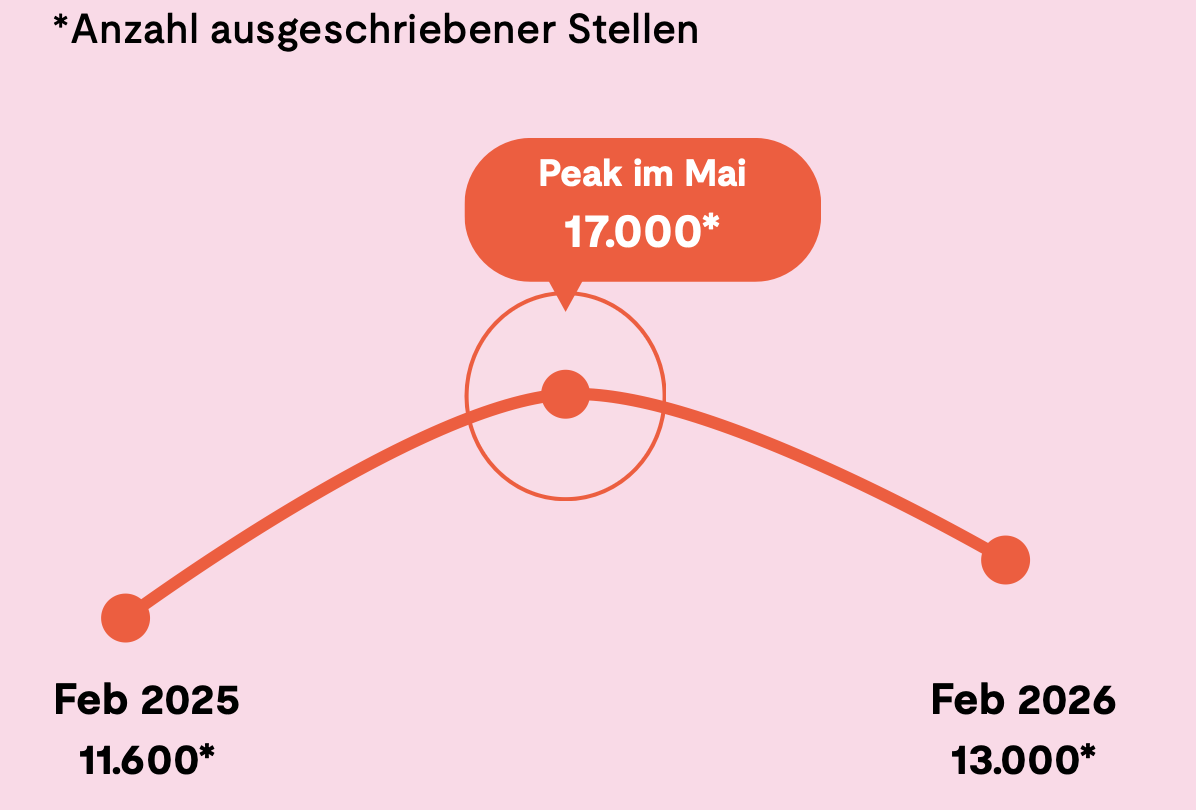
Labour Market 2025/2026 Comparison
Warehouse workers in focus - a data-driven analysis.